
Six Thoughts About Saturday Love
Choreographed and Performed by Zoë Whittle

Photo of final performance by Justin Hayworth.
Initial Vision and Pitch
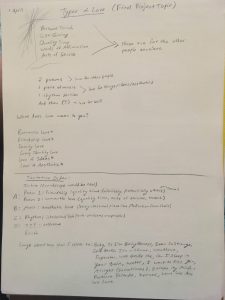

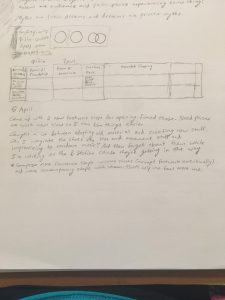
My vision changed very little from the initial theme, order, and overall content to the final version, but the presentation of all of the elements ended up shifting fairly drastically.
Showings in Class and Peer Critical Response
For my first showing of the work in class, I had my entire “quiet corner section” and a rough version of the “footwork” section, which eventually became sections four and five, respectively.
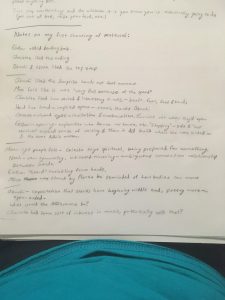
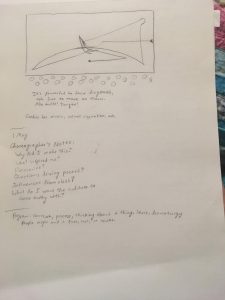
After that first showing, I turned a lot of attention to story arc:

And to music ideas:
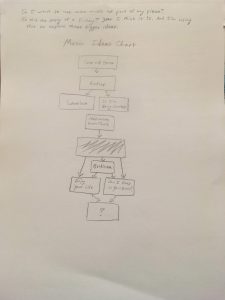
I began to imagine the piece as the story of a Friday after classes, spending some time with friends, with my significant other, and then alone.
When I showed my second version (which was very similar to the first one but with the addition of an opening), I asked my classmates for ideas about sound. Their ideas helped a lot because although I ultimately used very little of them, they helped guide and inform my process as I experimented with various nature sounds including birds and thunder, as well as three pieces of classical music.
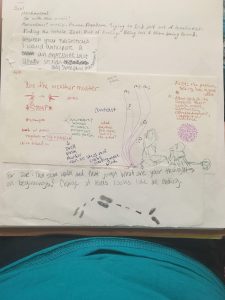
After receiving more feedback both in and outside of class, I changed the story to a Saturday. I threw out the poetry I had originally written and replaced it with prose, talking about an afternoon of friendship, an evening of romance, and I night trying to love myself.
As I worked on my sound, I also created the movement for my “friendship” and “romance” sections. For the former, I created movement from interjections and random words said frequently between friends (“worm,” “yikes,” etc.). For the latter, I used a series of pronouns as well as the prepositions “beside” and “beyond.”
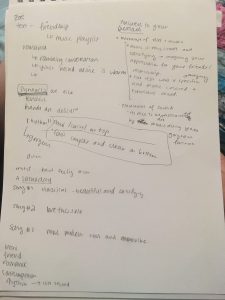
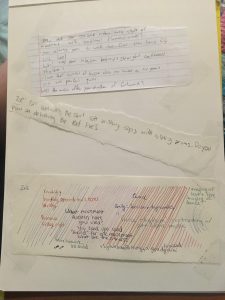

First Iteration of the Final Version
The following video shows the first time I felt like all of the pieces came together. I wasn’t satisfied with the ending because I couldn’t decide between tapering off and building to a pitch, but the rest of the sections felt right, and the movement seemed to tell the story I wanted it to.
After playing around with endings a bit more, I found one I liked.
I edited together the following audio file: The opening of “Largo” from the Winter section of Vivaldi’s Four Seasons (punctuated by thunder), a recording of me reading the “friendship” and “romance” text over bird sounds, a section of “Méditation from Thaïs (the only part I kept), a recording of me speaking fragments of definitions of the word “love” punctuated by more thunder, and finally the first third of “Boadicea” by Enya. I planned on delivering my final text live.
When I rehearsed the final piece with this audio file, I did not like the resulting product. I tried to make my artistic vision fit together because I had really wanted to have a clear narrative, but I hated it. I threw out the text, the nature sounds, and most of the music and replaced it with water sounds. I knew that my audience would read meaning into the water, which was not a part of my initial vision, but I liked it. The water kept things simple and allowed my movement to shine, as I had always truly wanted.
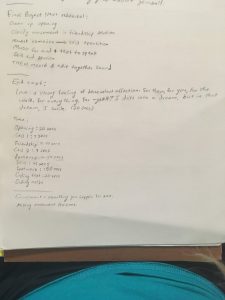
Read the written outline of the piece here.
Check List Reflection
“Symmetry has been ingrained in me as a dancer for years, and I tend to like order and balance in all aspects of my life, which, when it comes to movement, is not always an interesting or positive thing—although Humphrey admits that it is “good for calm states of being” (159). My delicious movement is symmetrical. My default tendency is to repeat a movement or phrase on the other side of my body to bring that sense of balance. In this piece, I’m trying to work more with asymmetry so that those delicious moments of symmetry can stand out more rather than being boring.”
Read the full text here.
Choreographer’s Notes
“On an aesthetic level, I wanted to experiment with a melding of flamenco and modern/contemporary dance styles. I created six distinct sections, and I followed a different process for creating movement with each one.”
Read the full text here.
The End of the Process Road
I showed the piece one final time in class, resulting in lovely comments from my classmates and no change in form but a reinforcement of intention.


I have included the video of the dress rehearsal rather than the final performance because I feel that this video is the best representation of the piece.
Video by Nolan Schoenle. Lights by Nolan Schoenle and Anjali Jain. Costume by Haley Jo Licha. Audio: “Méditation from Thaïs” by Jules Massenet and various water sounds from Freesound.org. Selected footwork steps by Mina Fajardo. Subida at the end of the footwork section from traditional flamenco. All other movement choreographed by Zoë Whittle. Performed by Zoë Whittle.
Artist’s Statement
When I dance, I feel a connection between the physical, the intellectual, and the aesthetic sides of myself. I can dance purely for fun, or I can dance for another purpose, and it still brings me that same joy. In my dance, I strive to tell stories — emotional, visual, narrative, or otherwise — and to bring joy to my audience. At the very least, I want the people watching to feel something, even if that something is not always positive. I bring many years of training in flamenco and contemporary dance and strive to mix the theory from the latter with the forms and traditions of the former. I try to tell my own stories, in whatever form they take. I acknowledge those who have come before and those who will come after, and especially the flamenco dancers in Spain, New Mexico, and elsewhere who have taken the form to its current state and have given me access to a culture not originally my own.

